
Early morning rain in Delhi lowers temperatures. The weather office predicts cloudy conditions and thunderstorms for the day due to a western disturbance.

Cyclone Shakhti, the first cyclonic storm of the post-monsoon season in the Arabian Sea, has intensified.

Sri Lanka's Department of Meteorology issued a special bulletin on Friday morning, warning the public about possibility of rain in Colombo on Sunday.

Several states in north India, including Rajasthan and Himachal Pradesh, experienced varied weather conditions, including light to moderate rainfall, fog, and temperature fluctuations.

The heatwave alert has been issued for Mumbai, Thane, Raigad and Ratnagiri on February 25 and 26, the IMD said.

Delhi's air quality deteriorates to 'very poor' levels, sparking a blame game between AAP and BJP over the causes and responsibility for the pollution.

"Montha over westcentral Bay of Bengal moved north-northwestwards with a speed of 17 kmph during the past six hours and lay centred at 2.30 am on October 28 over the same region about 230 km south-southeast of Machilipatnam (and) 310 km south-southeast of Kakinada," said the Met Department in a release.
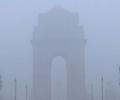
The India Meteorological Department (IMD) reported that very dense fog began forming around 5.30 am, resulting in a thick haze over different parts of the national capital.

Delhi's air quality deteriorated to the 'severe' category, prompting the implementation of Stage-IV GRAP measures and hybrid classes for schools.

The national capital was in the grip of a cold wave, with the sun largely obscured by clouds and pollutants lingering in the atmosphere, leading to reduced visibility. At least 129 flights were cancelled at the Delhi airport on Saturday due to dense fog, according to an official.
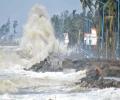
Cyclone Ditwah is moving towards the Tamil Nadu coast, bringing the threat of heavy rainfall. The state government is reviewing preparedness measures, and a red alert has been issued for southern and delta districts.

The India Meteorological Department issued an orange alert of heavy rains for Mumbai for Wednesday, and predicted the intensity of rainfall in the metropolis will go down from Thursday.

The IMD has predicted "heavy to very heavy" rainfall in Mumbai on Sunday.

In a post on X in the morning, IndiGo said there was heavy downpour over Delhi, causing some temporary disruption to flight schedules.

'Monsoon is the pran (life) of our water system.' 'A weak monsoon will have a very negative impact on crops and people's lives.'

The forecast has an error margin of four days, which is considered normal

Mumbai recorded its coldest day on Monday since December 24, 2015 with the temperature dipping to 13.7 degrees Celsius, an India Meteorological Department official said.

For March 22, an Orange Alert has been issued while a Yellow Alert has been issued for Sunday.

The IMD has red and orange alerts for the hours ahead.

A severe cold wave has intensified across North India, with Delhi recording its lowest temperature of the season. Rajasthan experienced sub-zero temperatures, and several states have issued alerts and closed schools due to the extreme conditions.

A thick layer of toxic smog enveloped the national capital on Saturday as air quality deteriorated sharply, prompting the Commission for Air Quality Management (CAQM) to invoke the strictest curbs under Stage IV of the Graded Response Action Plan (GRAP) across Delhi-NCR.

Above-normal cold wave days are expected in some areas of central India, eastern Uttar Pradesh and Bihar during January 2026.

Heavy rains continue to batter Tamil Nadu, causing a rise in reservoir levels and prompting a red alert. Schools and colleges are closed in several districts as authorities prepare for potential flooding.

Delhi choked under a thick blanket of smog on Monday, with the Air Quality Index (AQI) settling at 498, which falls in the higher spectrum of 'severe' category.

The aircraft, later, flew to Guwahati after an improvement in the weather conditions in Guwahati, said KC Meena, the director of the Maharaja Bir Bikram (MBB) Airport at Agartala.

The India Meteorological Department (IMD) has predicted above-normal rainfall for most parts of India during the post-monsoon season (October to December), except for some areas in the northwest. The southwest monsoon season ended with the country recording eight per cent above normal rainfall.

North India is shivering under an intense cold wave as temperatures plummet across the region.

The record monsoon rains across India during the June to September months was 937.2 millimetres, the 5th-highest since 2001 and 38th-highest since 1901.

Heavy rains lashed Mumbai, slowing traffic and affecting train services. The IMD has issued an 'Orange' alert, advising citizens to stay indoors.
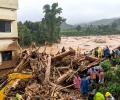
A red alert indicates heavy to extremely heavy rain of over 20 cm in 24 hours. An orange alert means very heavy rain of 11 cm to 20 cm, and a yellow alert means heavy rainfall between 6 cm and 11 cm.

The BCCI press conference scheduled at 1.30pm in Mumbai is 'expected to be delayed owing to weather disruptions'.

Mumbai recorded a minimum temperature of 16.5 degrees Celsius on Friday, the lowest for November in the last eight years, the India Meteorological Department (IMD) said. This temperature was recorded by the Santacruz observatory, which records weather parameters for Mumbai's suburbs. The Colaba observatory, which records weather parameters for the island city, registered a minimum temperature of 21.4 degrees Celsius during the same period. There is no cold wave alert for Maharashtra from November 30 to December 3, and temperature is set to rise.

A landslide triggered by continuous rainfall has disrupted traffic on National Highway 75 near Kadaba taluk in Dakshina Kannada district, halting vehicular movement between Bengaluru and Mangaluru. Authorities are working to clear the debris and restore traffic flow.

IMD weather forecast predicted a moderate to intense spell of rain in these areas for the next three to four hours.
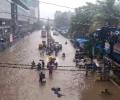
Heavy rains in Maharashtra have caused floods, road blockages, and widespread damage, resulting in casualties and displacement. The state government is monitoring the situation and coordinating rescue efforts.
The India Meteorological Department (IMD) has forecast cloudy skies with the possibility of heavy rainfall at a few places in the city and suburbs in the next 24 hours.

Delhi experiences a biting chill with 'cold day' conditions and dense fog, coupled with 'very poor' air quality. The IMD forecasts continued cold weather and potential light rain.

The India Meteorological Department (IMD) forecasts the withdrawal of the southwest monsoon from northwest India around September 15. This year's monsoon covered the country earlier than usual, resulting in surplus rainfall and extreme weather events.

Heavy rains in Nanded, Maharashtra, have caused severe flooding, leading to the evacuation of hundreds of residents as the Godavari and Asna rivers overflow. The Vishnupuri dam released a large amount of water, exacerbating the situation.
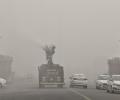
Delhi is preparing for its first artificial rain through cloud seeding to combat air pollution. A trial run was successful, and the first rainfall is expected on October 29 if weather conditions are favorable.
